Business Waste Removal Docklands — Recycling and Sustainability
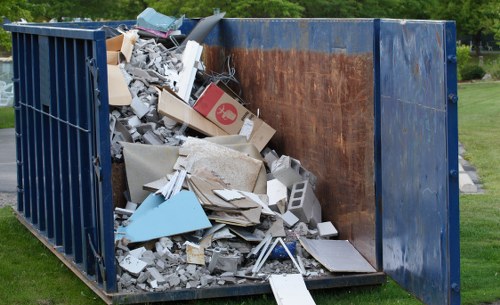 Welcome to our sustainability statement for Business Waste Removal Docklands, where we focus on creating an eco-friendly waste disposal area and a truly sustainable rubbish area for offices, retail, and light industry across the Docklands. Our approach combines practical recycling solutions, clear separation systems aligned with borough policies, and measurable targets so that businesses can reduce landfill, cut carbon, and participate in the local circular economy.
We set a clear recycling percentage target for commercial waste streams and publicly report progress. Our current corporate goal is to reach a 70% recycling rate for all collected dry and organic wastes within three years, moving steadily toward higher recovery rates by investing in segregation, reuse and partnerships. To support an eco-conscious waste removal service, we operate route optimization software and a fleet of low-emission vehicles so that sustainable rubbish collection is low-impact and reliable.
 The Docklands sits across several boroughs with varying approaches to waste separation — notably Tower Hamlets and Newham — and we tailor collections to match local rules. Many boroughs emphasise separate streams for paper and card, glass, metal, and food waste; others require dry mixed recycling with specific sorting at transfer stations. Our teams train on borough-specific requirements, label bins clearly, and provide guidance materials so businesses comply while maximising diversion from landfill.
We use local transfer stations and materials recovery facilities (MRFs) that serve East London to ensure loads are processed as close to source as possible. By minimising haul distances to transfer stations — for example facilities serving Beckton, Poplar and nearby wharves — we reduce journey emissions and speed up turnaround. These local transfer stations are key to creating an effective eco-friendly waste disposal area in Docklands because they enable high-quality sorting and onward recycling.
 A central element of our sustainable rubbish programme is partnerships with charities and social enterprises. Rather than consigning reusable items to landfill, we divert the following where possible:
- Office furniture — desks, chairs and shelving refurbished and redistributed to community organisations;
- IT and electronics — tested, wiped and donated to educational charities or refurbished for resale;
- Surplus fixtures and fittings — building materials and lightly used items offered to social projects.
These collaborations help create local social value, reduce resource extraction, and ensure more materials remain in productive use. Our partnerships include local charities, employment-focused social enterprises and reuse centres that specialise in handling business-grade donations.
To make the transition to a low-carbon, circular service, we measure and audit results. Monthly reporting tracks tonnages diverted, contamination rates, and the percentage of each waste stream recycled. These audits inform staff training and collection frequency adjustments so that the sustainable rubbish area is continually improving.
Fleet and logistics are central to delivering an effective commercial waste solution in Docklands. We operate a growing number of low-carbon vans and hybrid vehicles, and are trialling electric collection vans on shorter urban routes. Combined with route planning that reduces empty-running miles, this approach lowers our direct emissions and supports clients' Scope 3 reporting ambitions.
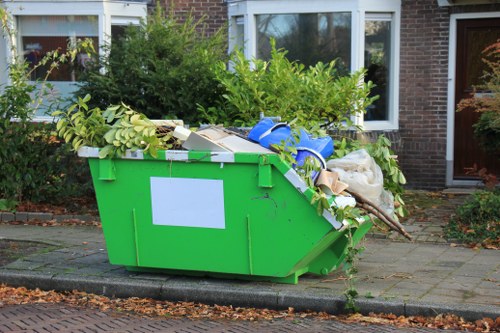
Tailored Solutions for Docklands Businesses
We supply a range of bin types and signage to reflect the boroughs' approaches and client needs. Options include dedicated streams for:- Paper and cardboard (source-separated to preserve quality)
- Glass and metal containers
- Food and organic waste (for anaerobic digestion or composting)
- E-waste and batteries (handled under WEEE regulations)
- Construction and demolition materials (segregated for recycling)
We also provide tailored staff training sessions and on-site signage to improve compliance. Small behavioural changes in businesses can yield large improvements in recycling percentage, contamination levels and overall sustainability outcomes.
 Accountability and transparency are core principles: we provide clear documentation on tonnages recycled, routes to local transfer stations, and records of charitable donations and reuse. Our ambition is to support Docklands in becoming a benchmark for urban sustainable waste management: a genuine eco-friendly waste disposal area and an inclusive sustainable rubbish area where materials are valued, emissions are lowered, and community benefits are maximised.
